

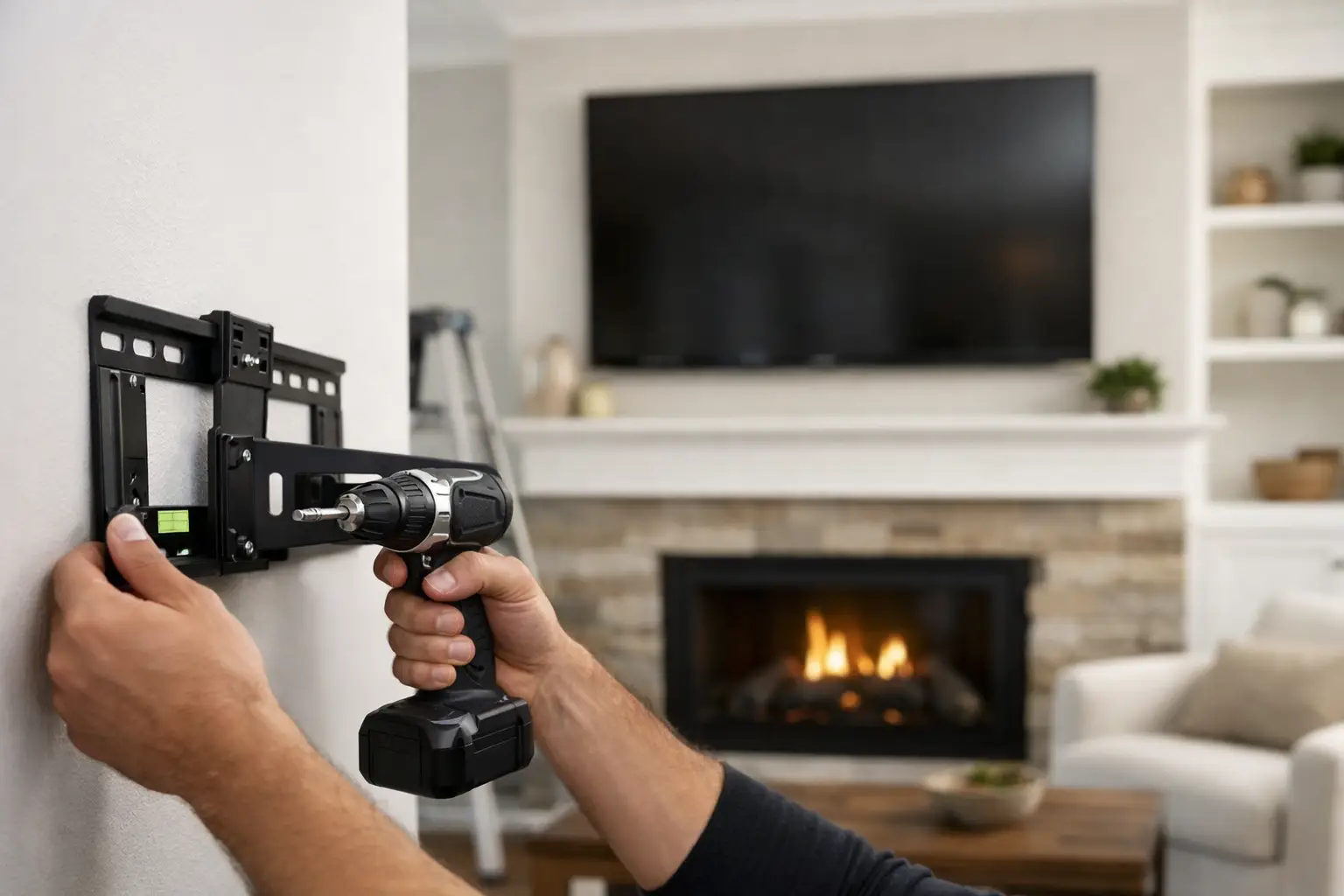
A TV over the fireplace can look clean and modern right up until the screen sits too high, the wall can’t support the mount, or heat starts shortening the life of the electronics. If you’re figuring out how to mount tv above fireplace the right way, the goal is not just appearance. It’s safety, comfort, and a setup you won’t regret every time you turn it on.
Should you mount a TV above a fireplace?
Sometimes yes. Sometimes absolutely not.
This is one of those home projects where the answer depends on the fireplace type, how much heat it gives off, the wall construction, and how you use the room. A gas fireplace with a substantial mantel and low heat transfer may be workable. A wood-burning fireplace with strong rising heat and soot is usually a much tougher case.
The biggest trade-off is simple. The fireplace often creates the best visual focal point in the room, but it rarely creates the best viewing height for a television. If the TV ends up too high, you may get neck strain during longer viewing sessions. So before you think about mounts, anchors, or cable routing, decide whether this is truly the right wall.
What to check before mounting
When homeowners ask how to mount tv above fireplace areas safely, these are the first things worth checking.
Heat exposure matters more than most people think
Electronics do not like heat. Even if the wall itself feels fine to the touch, the area directly above a fireplace can still get warmer than recommended for your TV over time. Manufacturer guidelines vary, so it’s worth checking the maximum operating temperature for your specific model.
A practical test helps. Run the fireplace for a while, then feel the wall where the TV would go. Better yet, use an infrared thermometer. If the wall is getting noticeably hot, that installation may not be a good idea without a mantel or other barrier that redirects heat.
The fireplace type changes the risk
Electric fireplaces are usually the easiest option because many direct heat outward rather than straight up. Gas fireplaces vary widely. Wood-burning fireplaces tend to create the most heat and residue, which can make a mounted TV a poor long-term choice.
Wall material affects how the mount is installed
Drywall over wood studs is straightforward if the stud layout works with your mount position. Brick, stone, and tile can be much more complicated. Natural stone especially can be uneven, brittle, or difficult to drill cleanly.
This is where DIY plans often start to unravel. A mount is only as secure as what’s behind it, and fireplace walls are not always simple framed walls.
Viewing height still matters
A beautiful install can still be uncomfortable to watch. Ideally, the center of the TV should land near seated eye level, but above a fireplace that is often impossible. If the screen must go higher, a tilting or pull-down mount can make a big difference.
Choosing the right mount for above-fireplace installs
Not all mounts are a good fit for this location.
A fixed mount gives the slimmest look, but it offers the least flexibility. If the TV sits high, glare and viewing angle issues can become annoying fast. A tilting mount usually makes more sense because it angles the screen downward toward the seating area.
In some rooms, a pull-down fireplace mount is the better answer. It lets the TV rest higher when not in use and come down to a more comfortable height when you’re watching. These mounts cost more and need careful installation, but they can solve the biggest problem with fireplace placement.
You’ll also want to confirm the mount matches both the TV size and weight. That sounds obvious, but it’s one of the most common mistakes. The mount rating, the hardware, and the wall structure all need to work together.
How to mount TV above fireplace step by step
If the wall passes the heat test and the location still makes sense for your room, the process should be planned carefully.
1. Find the exact placement
Start by measuring the fireplace, mantel, and available wall space. Mark where the TV will sit and check sightlines from your main seating position. Painter’s tape helps you outline the TV on the wall so you can see how it will actually look.
This is also the time to account for clearance above the mantel. You want breathing room between the fireplace feature and the bottom of the TV, both for appearance and for heat separation.
2. Locate the structural support
On a standard drywall wall, that usually means finding studs. On masonry, it means identifying solid anchor points and using the right fasteners for brick or stone. Never rely on drywall anchors alone for a full-size TV over a fireplace.
If the stud placement doesn’t line up with your desired center point, a professional may use a mounting plate or other secure method to bridge the gap. The right solution depends on the wall, not guesswork.
3. Plan power and cable routing
A clean install is about more than getting the TV on the wall. You also need a plan for power, streaming devices, soundbars, and hidden cables.
Visible cords hanging over a fireplace ruin the finished look, and running power incorrectly creates safety issues. In many homes, adding a recessed outlet behind the TV and an organized path for low-voltage cables is the cleanest option. If you’re using a soundbar, think through that placement before the TV goes up, not after.
4. Install the mount level and secure
Use the manufacturer template if provided. Measure twice, then measure again. Even a slight tilt is very obvious above a strong visual feature like a fireplace.
Once the wall plate is installed, check every lag bolt, masonry anchor, or mounting point. This is not the place to rush. A secure mount should feel solid before the TV ever goes on it.
5. Attach and test the TV
After the brackets are attached to the TV, lift it into place carefully. Then test the tilt, pull-down action, or articulation if your mount includes those features. Make sure the TV clears the mantel and that cords are not pinched or strained.
Finally, turn the fireplace on and monitor the area during use. A setup that looks great still needs to perform safely over time.
Common problems homeowners run into
The biggest issue is mounting too high just because the wall is available. A TV can technically fit above a fireplace and still be in the wrong place for comfortable viewing.
The second problem is underestimating the wall material. Brick and stone fireplace surrounds are much less forgiving than standard drywall. A bad drill point or weak anchor can turn a simple install into expensive damage.
Then there’s heat. Many people assume that if the fireplace doesn’t feel extreme, the TV will be fine. But repeated heat exposure can affect performance and lifespan gradually, not all at once.
Cable management is another frequent frustration. What seems like a quick install often ends with exposed cords, awkward device placement, or a soundbar that blocks part of the fireplace detail.
When professional help makes sense
This project can be DIY-friendly in the right room with the right wall and the right tools. But above-fireplace mounting has more variables than a standard wall mount in a bedroom or office.
If you’re dealing with stone, brick, tile, uncertain stud placement, high heat, or a pull-down mount, professional installation is often the better route. It saves time, helps avoid wall damage, and gives you more confidence that the TV is mounted securely and at the right height.
For busy homeowners and renters, that peace of mind matters. A stress-free setup is not just about convenience. It’s about knowing the mount is secure, the screen is positioned well, and the finished look feels clean from day one. That’s why many Central Texas customers choose a trusted service partner like Smart Solutions TX for installs that need to be done carefully and correctly.
Is mounting above the fireplace the right move?
If the fireplace wall stays within safe temperature limits, the structure can support the mount, and the viewing angle works for your room, then yes, it can be a strong setup. If any one of those pieces is off, the better answer may be a nearby wall, a different furniture layout, or a pull-down mount that brings the screen closer to eye level.
A good TV installation should make the room easier to enjoy, not leave you adjusting your posture, worrying about heat, or second-guessing the wall support. The best setup is the one that looks good, works comfortably, and stays secure long after installation day.