

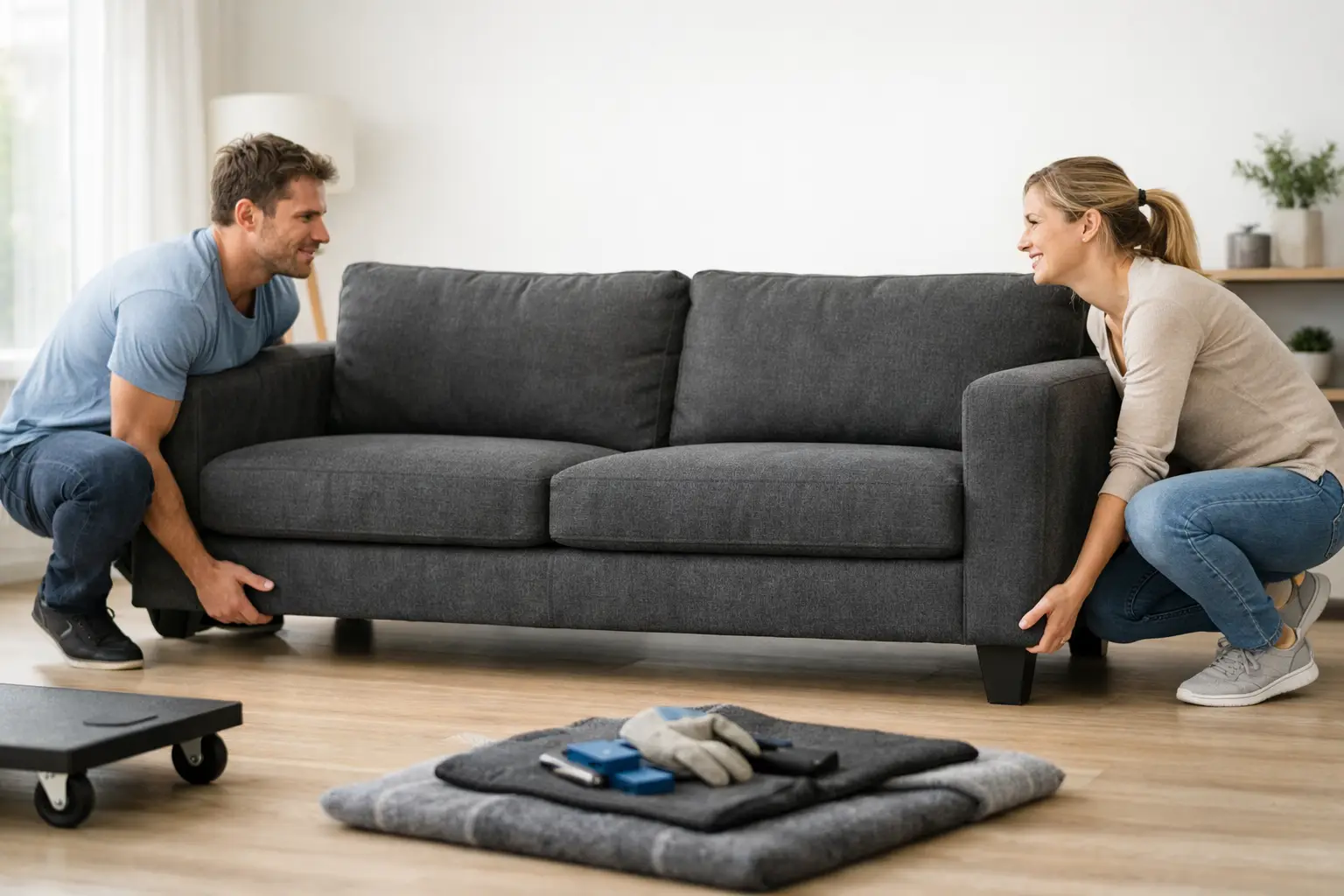
That couch always seems manageable until it catches on a doorway, scrapes a wall, or suddenly feels twice as heavy halfway down the hall. If you’re trying to figure out how to move a heavy couch safely, the real goal is not just getting it from one room to another. It’s getting it there without hurting your back, damaging your home, or turning a simple move into an all-day problem.
The safest couch move starts before anyone lifts a corner. A few minutes of planning can save you from torn upholstery, gouged trim, and the kind of awkward pivot that leaves someone sore for days.
How to move a heavy couch safely starts with prep
Before you touch the couch, clear the full path. That means rugs, shoes, toys, side tables, lamps, and anything else that can catch a foot or block a turn. Measure the couch, then measure the doorways, stair openings, hall width, and any tight corners. Many people skip this step and end up forcing furniture where it was never going to fit at that angle.
If the couch has removable legs, cushions, or a detachable frame section, take them off first. A lighter couch is easier to control, and reducing bulk often matters more than reducing weight. Keep screws and hardware in a labeled bag so reassembly is simple later.
Protecting the couch and the home matters too. Furniture blankets help prevent fabric snags, wood scuffs, and damage to walls during tight turns. Stretch wrap can hold loose cushions and moving blankets in place. If you’re crossing hardwood, tile, or delicate flooring, put down protective material before you start.
Use the right moving tools, not just muscle
Knowing how to move a heavy couch safely often comes down to using leverage and support instead of brute force. Carrying a full-size sofa with bare hands is where people get into trouble.
Furniture sliders are useful if you’re moving the couch across a room on a hard surface. They reduce friction and help you guide the piece instead of dragging it. For longer moves, a furniture dolly can take a lot of strain off your body, but only if the couch is balanced securely and the path is flat enough to support rolling.
Lifting straps can also help, especially with bulky sectionals or sleeper sofas, but they are not foolproof. They work best when both people are coordinated and the couch shape allows for even support. If one side is heavier or the load shifts unexpectedly, straps can create a false sense of control.
Gloves with good grip are a smart addition. Slick upholstery or polished wood arms can slip at the worst moment, especially when you’re turning through a doorway.
Lift the couch the right way
The biggest mistake people make is trying to lift with their back while twisting at the same time. That combination is what causes strains fast.
Stand close to the couch before lifting. Bend at your knees and hips, keep your back as straight as possible, and grip underneath sturdy parts of the frame rather than pulling on cushions or thin arms. Lift smoothly with your legs. Avoid jerking the couch upward or trying to “catch” it mid-shift.
If two people are carrying it, communicate constantly. Decide who is leading, especially on stairs or around corners. Short, clear phrases like “stop,” “tilt,” “down,” and “pivot” work better than talking over each other once the couch is already in motion.
It also helps to keep the couch at a comfortable carrying height. Too low and you strain your back. Too high and you lose visibility and control. If you need to stop, set it down fully and reset your grip. Trying to rest while half-holding a couch is where fingers get pinched and loads get dropped.
How to move a heavy couch safely through doorways and tight spaces
Most couches don’t move straight out. They rotate, tilt, and angle through openings, and that takes patience.
Start by standing the couch on its end or side if the design allows it. The “high-low” method often works well through doors. One person carries the higher end while the other supports the lower end, allowing the couch to rotate and clear the frame gradually. This approach works especially well for narrow entries, apartment hallways, and stair landings.
Take the door off its hinges if you’re short on clearance. That small extra space can make the difference between a smooth move and scraped trim. Watch for light fixtures, handrails, low ceilings, and wall art as you turn.
If the couch refuses to fit, don’t force it. That usually leads to damage, not progress. Recheck your measurements, remove more components if possible, and try a different angle. Some oversized couches, recliners, and sleeper sofas simply need professional handling or partial disassembly.
Stairs change everything
Moving a couch on one level is one thing. Moving it up or down stairs raises the risk quickly.
The person on the lower end carries more weight, so that position should go to the stronger or more experienced mover. Go one step at a time and keep the couch tilted in a stable position. Sudden shifts are harder to correct on stairs, and even one missed step can lead to injury or serious property damage.
Make sure the stairway is fully clear and well lit. If the staircase is narrow, has sharp turns, or includes uneven outdoor steps, that is a good point to ask whether DIY is still worth it. A heavy couch can damage railings, walls, and door frames in seconds, and the cost of repairing those areas often exceeds the cost of getting help in the first place.
Know when not to do it yourself
There is a difference between a manageable move and a risky one. If the couch is a sleeper sofa, a large sectional, antique, extra-long, or unusually awkward to grip, the safer choice may be to bring in experienced movers. The same goes for third-floor walk-ups, tight stairwells, luxury flooring, and homes with narrow turns.
Time matters too. A lot of people start these moves already stressed, rushed, or tired from packing. That’s usually when corners get cut. If you need the job done quickly and carefully, professional help can turn a frustrating task into a straightforward one.
For homeowners and renters in Austin and Central Texas, Smart Solutions TX helps with hands-on moving labor that takes the guesswork out of heavy furniture moves. When you want a stress-free setup with background-checked technicians and added peace of mind, having reliable help can protect both your home and your schedule.
Common mistakes that make couch moving less safe
Dragging the couch across the floor is one of the most common problems. It can tear fabric underneath, crack legs, and leave scratches that are expensive to fix. Another issue is lifting by weak points like armrests or recliner footrests, which are not built to carry the full load.
People also underestimate how much space they need to turn. A couch might fit through a doorway on paper but still be difficult to rotate in a narrow hallway. And while it may seem faster to move with one person, large couches almost always require at least two people for safe control.
Finally, don’t ignore your body during the move. If something feels too heavy, too awkward, or too unstable, stop. Pushing through usually makes the outcome worse, not better.
A safer move is usually a slower move
If you’re learning how to move a heavy couch safely, the best approach is simple: prepare the path, reduce the weight where you can, use proper equipment, and move in controlled steps. There is no prize for finishing fast if the result is a strained back or chipped doorway.
Some couches are easy enough to handle with a second set of hands and a little patience. Others are better left to trained help. The smart move is the one that keeps everyone safe and gets the couch where it needs to go without adding more stress to your day.
When in doubt, slow down, measure again, and choose the option that protects your home, your furniture, and your back.