

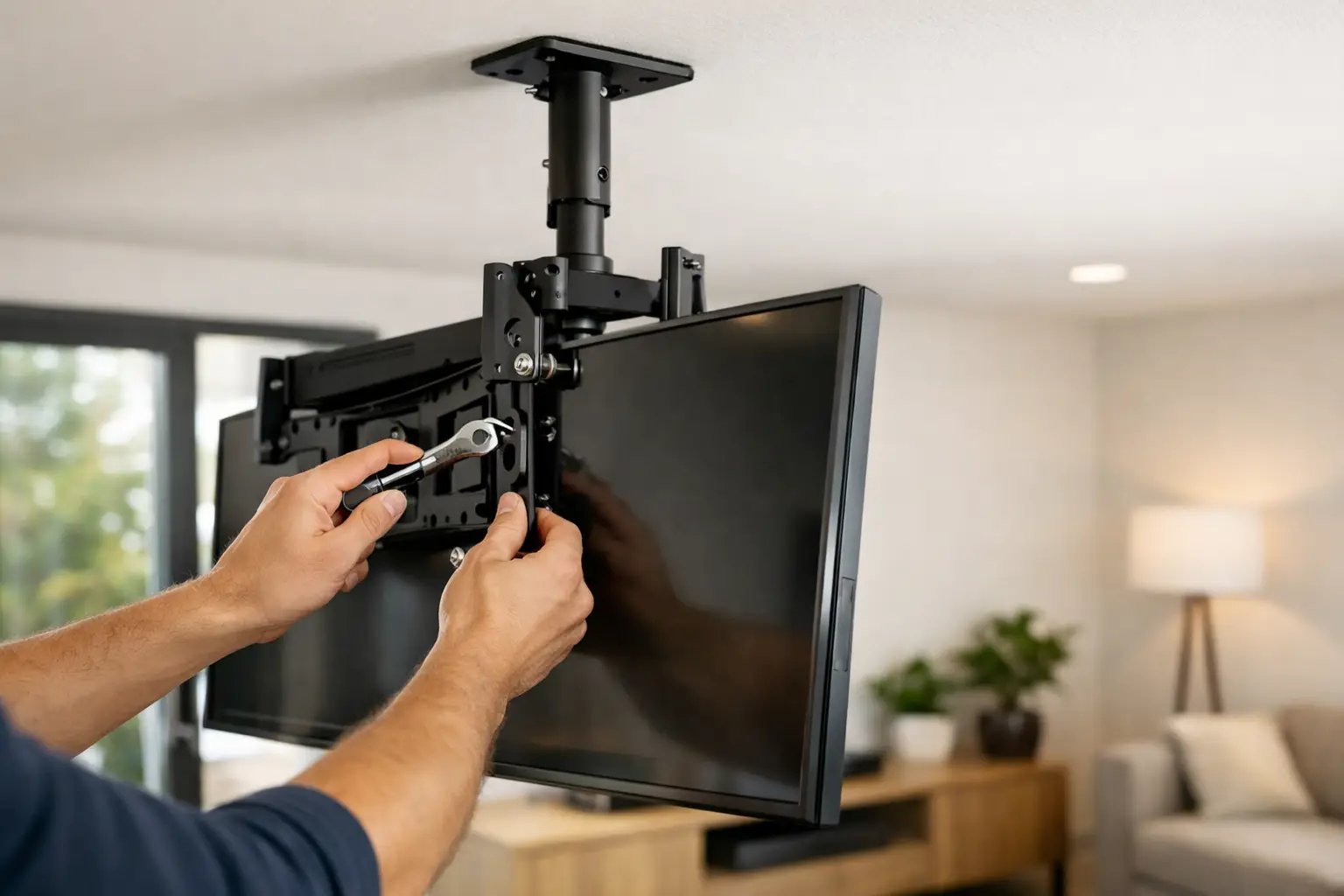
A ceiling-mounted TV can solve a problem that wall mounting simply cannot. Maybe the room layout leaves no good wall to use. Maybe you want a screen in a bedroom corner, a patio, a gym, or a commercial-style living area where every inch matters. When done correctly, ceiling tv mount installation gives you a clean setup, better sightlines, and more usable space. When done poorly, it can leave you with drywall damage, a crooked screen, or worse, a safety risk hanging overhead.
That is why this is one of those projects where the details matter more than people expect.
When ceiling tv mount installation makes sense
Ceiling mounting is not the default choice for most homes, but it can be the best one in the right room. It works especially well when large windows take up the walls, when furniture placement limits your viewing angle, or when you want the TV visible from multiple spots without dedicating an entire wall to it.
This setup is also common in bedrooms with adjustable viewing positions, covered patios, garages, workout rooms, and open-concept spaces. In rentals, it can sometimes be a workaround when wall options are limited, although permission from the property owner is still a must.
The main appeal is simple – it frees up wall space and often creates a cleaner layout. But the trade-off is that overhead mounting asks more of the structure, the hardware, and the installation process.
What makes a ceiling mount more complex than a wall mount
People often assume a ceiling mount is just a wall mount turned sideways. It is not. Gravity works differently here, and the load path matters more. Instead of fastening into vertical framing the way many wall mounts do, ceiling tv mount installation usually depends on joists, beams, or other solid structural support above the drywall.
That changes everything from bracket selection to bolt placement. It also affects cable management, screen height, tilt range, and how stable the TV feels during everyday use.
Some ceilings are straightforward. A standard flat ceiling with accessible joists is usually the simplest scenario. Others are more complicated, like vaulted ceilings, drop ceilings, older homes with inconsistent framing, or rooms where the ideal viewing location does not line up neatly with structural support.
In those situations, there is rarely a one-size-fits-all answer. The right approach depends on the TV size, ceiling type, mount design, and how the room is used.
The first question is not where the TV should go
It is what can safely support it.
A proper installation starts with locating solid framing and confirming the mount is rated for the television’s weight and size. That sounds obvious, but it is where many DIY attempts go wrong. Anchors rated for light fixtures or decorative items are not the same thing as hardware designed to hold a television overhead.
There is also the issue of movement. A ceiling-mounted TV may be fixed, tilting, swiveling, or attached to a drop-down pole. The more adjustability you want, the more critical the support and hardware become. A fully adjustable mount gives you flexibility, but it can also introduce more leverage and strain at the connection point.
That does not mean adjustable mounts are a bad idea. It just means the installation has to match the hardware and the room.
Height, angle, and comfort matter more than most people think
One of the biggest mistakes in ceiling tv mount installation is placing the screen too high and assuming tilt will solve everything. Tilt helps, but it does not erase poor positioning. If the TV sits at an awkward angle, watching for two hours can leave you with neck strain instead of a better viewing experience.
In a bedroom, a higher mount may feel natural because the viewer is often reclined. In a living room or media room, the same height might feel uncomfortable fast. In a patio or gym, glare and standing sightlines become part of the calculation too.
This is where experience helps. The right mount location is not just about what looks centered in the room. It is about where people actually sit, stand, and move.
Cables can make or break the finished look
A ceiling-mounted TV gets attention. If the cables dangle visibly from the ceiling to the wall, the clean look disappears right away.
For many homeowners, the goal is not just a secure installation but a polished result. That usually means planning for cable routing before the bracket goes up. Depending on the room, that may involve using a mount with integrated cable management, routing lines through a path that keeps them concealed, or choosing a placement that minimizes visual clutter.
Power access is part of that conversation too. Extension cords are not a real solution for a mounted TV. You want a safe, code-conscious setup that looks intentional and works reliably with your devices.
Ceiling type changes the job
Not all ceilings are created equal, and this is where a quick online tutorial often stops being helpful.
Drywall over wood joists is common and usually workable, but it still requires precise joist location and proper fasteners. Concrete ceilings need different tools and hardware. Vaulted ceilings may require a mount designed specifically for angled surfaces. Drop ceilings are a category of their own and generally need attachment to structural support above the visible ceiling layer, not the tiles themselves.
Even in newer homes, framing may not be exactly where you want it. In older homes around Central Texas, you may run into uneven surfaces or previous patchwork that complicates the install.
That is why the best answer is often, it depends. The room may be perfect for a ceiling mount, but the method has to match the structure.
Why many homeowners decide not to DIY
There is nothing unusual about wanting to save money on home setup. But with overhead mounting, the margin for error is small. Missing a joist, using the wrong bolts, or mounting off-center can turn a simple project into drywall repair, replacement hardware, or a damaged TV.
There is also the time factor. Between stud finding, measuring, drilling, lifting, leveling, cable planning, and troubleshooting, a project that looks like a two-hour job can easily stretch much longer.
For busy professionals, families settling into a new place, or anyone trying to finish a move without adding another headache, hiring help is often the practical choice. The value is not just labor. It is confidence that the mount is secure, the TV is aligned, and the room looks finished when the job is done.
That is exactly why many local customers turn to Smart Solutions TX. The goal is simple: stress-free service, careful work, and the peace of mind that comes from having background-checked technicians handle the heavy lifting.
What to expect from a professional ceiling tv mount installation
A quality service appointment should feel straightforward from start to finish. First comes an assessment of the room, the ceiling structure, and your TV size. Then the installer confirms the right mount type, placement, viewing angle, and hardware for the surface.
During the install, precision matters. Measurements need to be accurate. The bracket needs to be level and anchored securely into proper support. The TV then has to be attached, adjusted, and checked for stability. After that, cable management and final positioning bring the whole setup together.
A good installer will also talk through practical details, like whether the chosen location affects glare, whether the mount gives you enough movement, and whether another spot in the room would create a better everyday experience.
That kind of guidance is often what separates a basic install from one that actually feels right once you live with it.
A few trade-offs worth considering before you book
Ceiling mounts are excellent in the right setting, but they are not always the best option. If your room has a perfectly usable wall at ideal viewing height, a wall mount may be simpler and less expensive. If you expect to move the TV often or change furniture layouts frequently, a ceiling location can feel less flexible.
You should also think about future access. If you switch streaming devices, soundbar components, or gaming systems, will it still be easy to reach your ports and cables? The cleaner the setup, the more planning that question deserves upfront.
Still, for rooms with limited wall space or unusual layouts, ceiling mounting can be the smartest solution by far. It just needs to be done with the same care you would want for any major fixture installed above your head.
If you are considering ceiling tv mount installation, the best next step is not guessing with a drill in one hand and a bracket in the other. It is making sure the setup fits your room, your structure, and the way you actually watch TV – because the right install should feel effortless long after the tools are gone.