

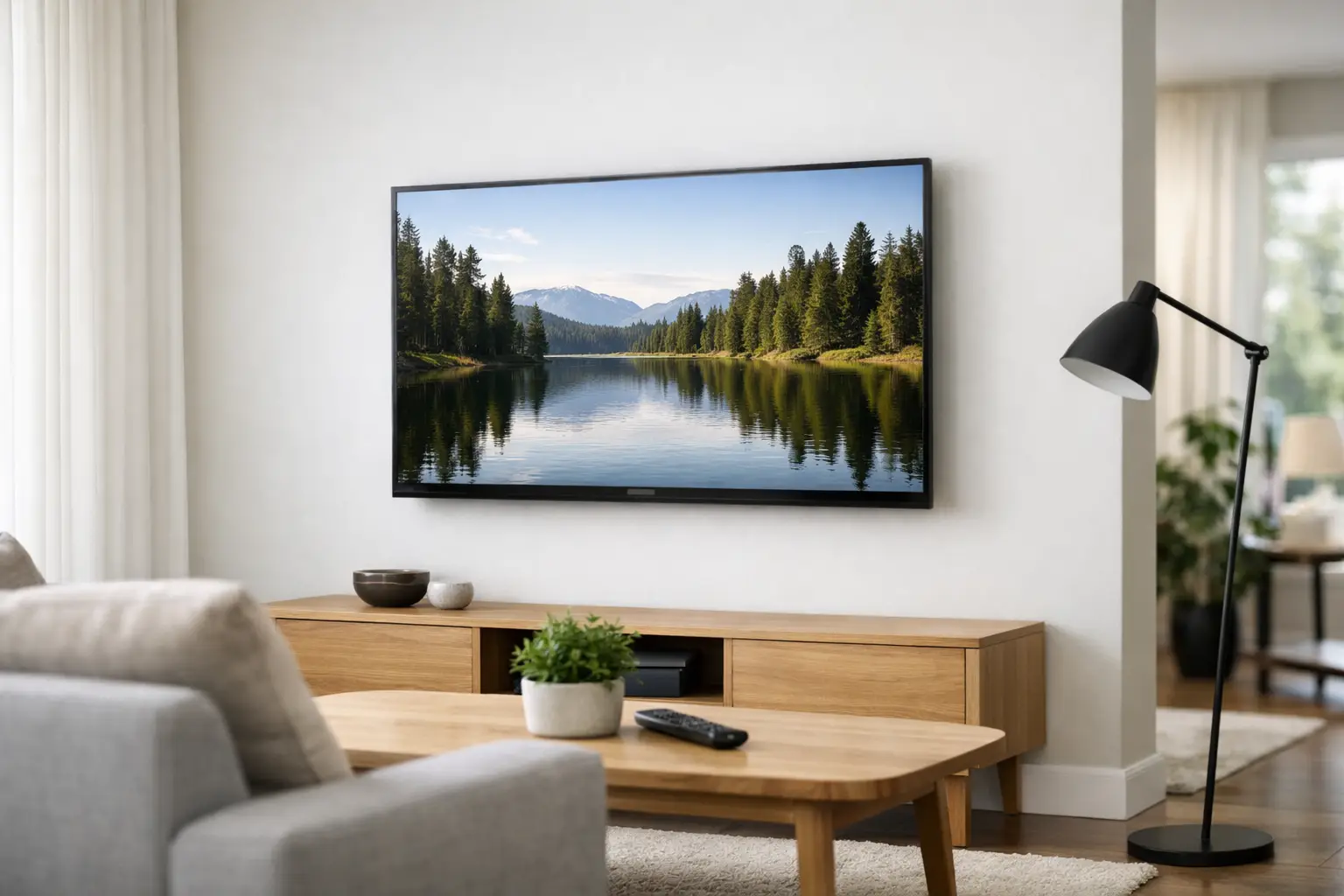
You notice a bad TV height faster than you think. If the screen is too high, movie night turns into sore necks and constant seat shifting. If it is too low, the room can feel awkward and the view gets blocked by coffee tables, decor, or people walking through.
A good tv mounting height guide for living room spaces starts with one simple goal: the center of the screen should sit close to your natural eye level when you are seated. That is what makes the setup feel comfortable, balanced, and easy to watch for hours at a time.
The tricky part is that eye level is not exactly the same in every home. Couch height, TV size, viewing distance, fireplace placement, and even who uses the room most all affect the best mounting point. That is why there is no single number that works for every living room.
A practical tv mounting height guide for living room comfort
For most living rooms, the center of the TV should land about 42 to 48 inches from the floor. That range works well for many standard sofas and sectionals, where seated eye level usually falls somewhere around 40 to 44 inches.
If you want a quick starting point, measure from the floor to your eyes while sitting in your usual spot. Then line up the center of the screen as close to that number as possible. This keeps your head in a relaxed position instead of tilted up the whole time.
With larger TVs, people sometimes assume they should mount the screen higher. Usually, the opposite is true. A bigger screen already fills more of your field of vision, so raising it too much can make the top edge uncomfortable to watch.
How to calculate the right height
The easiest way to find mounting height is to work backward from the center of the screen. First, find your seated eye level. Then measure the full height of the TV and divide that number by two. That gives you the distance from the center of the screen to either the top or bottom edge.
For example, if your seated eye level is 42 inches and your 65-inch TV has a screen height of roughly 32 inches, half of that is 16 inches. Place the center of the TV at 42 inches, and the bottom of the screen will sit around 26 inches from the floor.
That may sound lower than expected, but in many living rooms, it is exactly where the TV feels best. People are often used to seeing TVs mounted too high in showrooms, sports bars, or over fireplaces, and those setups do not always translate well to everyday home viewing.
A quick reference by TV size
Exact dimensions vary by model, but these common ranges help. A 55-inch TV often looks right with the center around 42 to 48 inches from the floor. A 65-inch TV usually fits in that same center-height range, with the bottom edge landing a bit lower. A 75-inch TV may still use a similar center point, but wall space, furniture, and viewing distance become even more important.
The key is to prioritize eye level, not just screen size. Bigger screen does not mean higher mount.
Viewing distance matters too
Mounting height and viewing distance work together. If your sofa is fairly close to the TV, even a slightly high screen can feel uncomfortable because your eyes have to travel upward more often. If the seating is farther back, you may have a little more flexibility.
That said, distance does not usually justify a dramatic height increase. In most living rooms, comfort still comes from keeping the center of the screen near seated eye level. If the room has multiple seating zones, aim for the primary couch or sectional, not the occasional chair in the corner.
When furniture changes the answer
The wall is only part of the equation. The console, media cabinet, soundbar, and nearby shelves all affect where the TV should go.
If the TV is mounted above a media console, leave enough space so the setup feels intentional and easy to clean around. In many homes, 4 to 8 inches between the top of the console and the bottom of the TV looks balanced. More space can work, but too much often makes the screen feel disconnected from the furniture below.
Soundbars are another factor people forget until the last minute. If one will sit below the TV, account for that before drilling anything. The goal is to keep the screen at a comfortable height while leaving proper clearance for the speaker.
Is mounting over a fireplace a bad idea?
Sometimes it is the only wall that works. Sometimes it is the only wall that looks good. But from a pure comfort standpoint, a fireplace mount often puts the TV too high.
That does not mean it is always wrong. It means there is a trade-off. You may get the cleanest focal point in the room, but you also may end up tilting your head upward every time you watch. Heat exposure, glare, and wiring can add more complications.
If the fireplace wall is your best option, there are ways to improve the result. A mount with tilt can help reduce neck strain. Some homes also benefit from a pull-down mount, which lowers the screen for viewing and brings it back up when not in use. Even then, the room should be measured carefully. What looks centered over a mantel is not always what feels comfortable from the couch.
The biggest mistakes homeowners make
The most common issue is mounting the TV based on standing eye level instead of seated eye level. It makes sense in the moment because you are looking at the wall while standing there. But the TV is usually watched while sitting down.
Another mistake is copying a photo online without considering the room. A setup that works in a staged home with extra-high ceilings may look off in an apartment living room. The same goes for assuming the wall studs line up exactly where the TV should go. Secure mounting always comes first, but placement should still be planned around comfort and symmetry.
People also underestimate cable management. Even the right height can look unfinished if cords are hanging below the screen or equipment placement was not considered ahead of time.
DIY vs professional installation
If you have the tools, know how to locate studs, and feel confident measuring carefully, mounting a TV can be a manageable project. But there is not much room for error. A few inches too high changes the way the room feels. Missing the right anchor points can create a bigger problem than bad placement.
For many homeowners and renters, the value of professional installation is not just getting the TV on the wall. It is getting it at the right height, in the right position, with a secure mount and a clean finished look. That matters even more with larger screens, tricky wall materials, fireplaces, or setups that include a soundbar and hidden wires.
For busy households in Austin and Central Texas, Smart Solutions TX helps take this off your plate with stress-free, secure TV mounting that is built around comfort, safety, and a polished result.
How to choose the best height for your room
Start with where you actually sit, not where the wall looks empty. Measure your seated eye level. Check the TV dimensions. Think about the console, soundbar, glare from windows, and whether the room is used mostly for casual streaming, sports, or long movie nights.
Then step back and test it before the final install. Painter’s tape on the wall can help outline the screen size so you can see how the height feels from the couch. This small step saves a lot of second-guessing later.
A living room TV should feel easy to watch and easy to live with. When the height is right, the room looks cleaner, the screen feels more natural, and the whole setup works the way it should.
The best mounting height is not the one that looks highest or most dramatic. It is the one that makes the room feel comfortable the second you sit down.